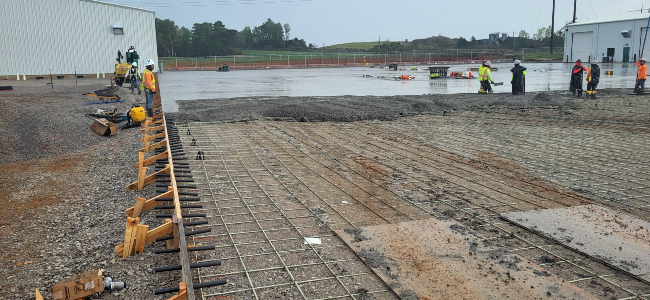
We are close to completion of a 1.2 million square foot concrete paving pour that we reinforced with fiberglass rebar (GFRP) in lieu of traditional reinforcing steel. Our customer has been impressed with the cost savings, and in the field, we’re seeing fiberglass rebar mats installed faster, with smaller crews and less equipment. We have found this process to be more efficient, and it ultimately delivers a cleaner, faster path to placement. These are the pluses we have experienced, however, it’s important to remember a few special circumstances when using GFRP. For example, there is no bending of fiberglass for shapes in the field. Because of its light weight, it can “float” during the pour, which requires greater attention. Also, the polymer binder is susceptible to being impacted by prolonged UV exposure.
Fiberglass rebar has higher tensile strength, significantly lighter weight and is more corrosion resistant than traditional steel rebar. For our paving on this project, these are all wins. Steel reinforcing remains the dominant material for reinforced concrete structures, but for flatwork and higher corrosion applications, fiberglass is a viable option.